
Sequence Logic for Early Minds
Developer: Clan Wanderer Games
Published: 2026-07-21
Updated: 2026-07-21
What players say
Sequence Logic for Early Minds stands out for its patient design. The puzzles start simple and grow slowly, letting children build skills at their own pace. The lack of timers or scores removes pressure, making it ideal for kids who need a gentle introduction to logical thinking. Parents will appreciate the ad-free, purchase-free environment. The only minor drawback is the absence of progress tracking, but the open-ended nature suits the intended age group well. Overall, a solid educational tool that respects a child's natural learning rhythm.
How to play
Observation-First Approach
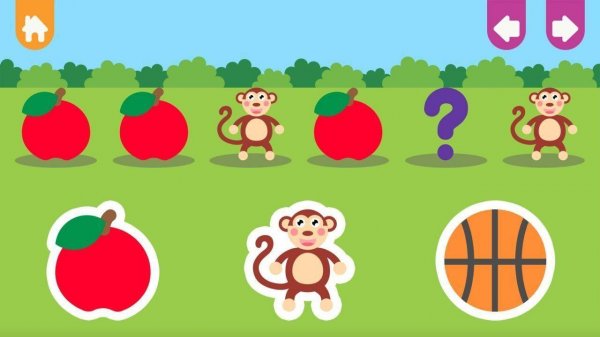
Children look at a row of items arranged in a repeating or alternating order. One spot is left blank. The task is to pick the correct item from a small set of choices to finish the sequence. This simple structure trains the eye to notice details like color shifts, shape rotations, or size changes. The pace is unhurried, giving each child time to think before tapping an answer.Gradual Complexity Curve
Early puzzles use two-item patterns with obvious differences, such as red circle, blue square, red circle, blue square. Later levels introduce three-item cycles, mixed attributes (color and shape together), and longer rows. This slow ramp-up helps children build confidence without sudden jumps in difficulty. Each new level feels like a natural next step rather than a frustrating leap.Positive Reinforcement Design
Correct selections trigger cheerful sounds and a brief animation. Wrong choices simply prompt the child to try again, with no penalty or negative feedback. This encourages persistence and reduces anxiety around mistakes. The interface uses large, clearly separated buttons that respond to both touch and mouse input, making it easy for small hands to interact accurately.Cross-Platform Accessibility
The game runs smoothly on tablets, smartphones, and desktop browsers. Screen layouts adjust automatically to fit different sizes, so the puzzle rows remain visible and tappable on any device. No downloads or accounts are required for basic play, allowing quick setup in classrooms or at home. The content is entirely offline after initial load, ensuring no distracting ads or external links appear during play.Real-World Learning Connections
Pattern recognition is a foundational skill for early mathematics and reading. By practicing with colored shapes, children strengthen the same mental muscles used for number sequences, letter order, and even musical rhythms. Parents and teachers can extend the learning by asking children to describe the pattern aloud or create their own sequences with physical objects after playing.Compatibility
Play on Any Device | Chrome / Safari / Edge Recommended
FAQ
What age group is Sequence Logic for Early Minds designed for?
The game is aimed at children aged 3 to 7. The simplest puzzles suit preschoolers just learning colors and shapes, while the later levels challenge early elementary students. Adults may need to explain the first few puzzles, but most children quickly grasp the concept and play independently.
Does the game include any in-app purchases or advertisements?
No. The game contains no advertisements, in-app purchases, or external links. It was designed as a completely safe, distraction-free environment for young learners. All content is included from the start, and no additional purchases are needed to access any level or feature.
Can I track my child's progress in the game?
The game does not include a built-in progress tracker or report card. It is designed for open-ended practice rather than formal assessment. Parents or teachers can observe which levels the child chooses and note any patterns of difficulty, but no scores or completion data are saved.
How many different puzzle levels are available?
The game offers a large number of puzzles arranged in increasing difficulty. The exact count is not specified, but the levels are designed to provide many hours of play without repetition. New puzzles are generated procedurally, so each session can feel fresh.
Is the game available in languages other than English?
The game uses minimal text, relying mostly on visual cues and icons. Instructions are simple and can be understood without reading. This makes it accessible to non-English-speaking children. However, the interface text is currently only in English.
What should I do if my child gets stuck on a puzzle?
Encourage the child to describe what they see in the row. Saying the items out loud can help them notice the pattern. If they remain stuck, you can cover the last item and ask what comes next. The game itself offers no hints, so adult guidance is helpful for building problem-solving strategies.







Comments
Sign in to comment
You must be logged in before posting a review or rating.
No account? Create one
No comments yet. Be the first to comment!